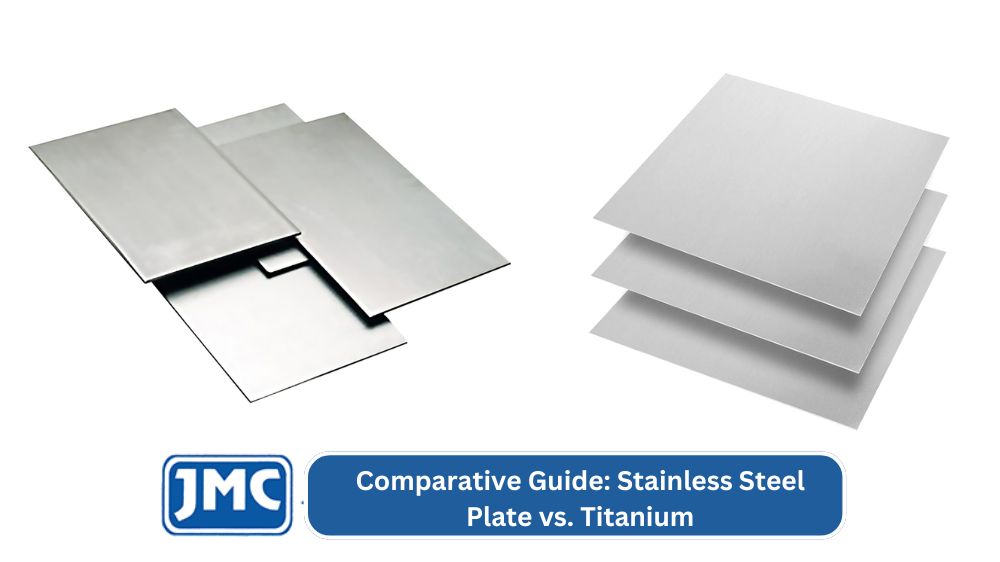
When selecting materials for demanding applications, stainless steel plates and titanium plates are two prominent options known for their superior strength, durability, and resistance to environmental factors. This stainless steel vs titanium detailed comparison explores their properties, advantages, disadvantages, and applications while including current price insights for India to guide you in making the best material choice for your needs.
Material Properties
Stainless Steel Plate
- Composition: Stainless steel plates are alloys primarily consisting of iron, chromium (at least 10.5%), and other elements like nickel, molybdenum, and carbon, depending on the grade. For example, 304 stainless steel contains 18% chromium and 8% nickel, while 316 contains 16% chromium, 10% nickel, and 2% molybdenum.
- Corrosion Resistance: Stainless steel offers excellent resistance to corrosion, particularly in mild environments. For more severe conditions, such as marine or chemical environments, higher grades like 316 offer enhanced protection.
- Strength and Durability: Stainless steel plates are known for their high tensile strength, making them suitable for structural applications. Grades such as 304 and 316 provide strong, durable performance, though specific properties can vary.
- Weight: Stainless steel plates are relatively heavy compared to titanium, which can be a disadvantage for applications where weight is critical.
- Cost: In India, stainless steel plate prices vary depending on the grade and thickness. Generally, prices for stainless steel plates range from ₹250 to ₹500 per kg, with 304 stainless steel plates being on the lower end of this spectrum and 316 stainless steel plates on the higher end.
Titanium Steel Plate
- Composition: Titanium is a metallic element often alloyed with small amounts of aluminum, vanadium, and other elements to improve its properties. Common alloys include Titanium Grade 5 (Ti-6Al-4V) and Titanium Grade 2.
- Corrosion Resistance: Titanium excels in corrosion resistance, even in harsh environments such as seawater and acidic solutions. It forms a stable, protective oxide layer that shields it from corrosion.
- Strength and Durability: Titanium is renowned for its exceptional strength-to-weight ratio. It is stronger than stainless steel relative to its weight, making it suitable for applications requiring high strength and minimal weight.
- Weight: Titanium is much lighter than stainless steel, which makes it ideal for applications where weight reduction is crucial, such as aerospace and automotive industries.
- Cost: Titanium is significantly more expensive than stainless steel. In India, titanium plate prices typically range from ₹3,000 to ₹6,000 per kg, depending on the grade and specifications. This high cost reflects the complex extraction and processing methods used in titanium production.
Mechanical Properties
Stainless Steel Plate
- Tensile Strength: Generally ranges from 520 MPa to 1300 MPa, depending on the grade. For example, 304 stainless steel has a tensile strength of about 520 MPa, while 316 can reach around 690 MPa.
- Hardness: Stainless steel has good hardness, though it is generally less hard compared to titanium. The hardness varies with the alloy and any heat treatments applied.
- Ductility: Stainless steel exhibits good ductility, allowing it to be easily formed and welded. This makes it suitable for a wide range of applications and fabrication processes.
Titanium Steel Plate
- Tensile Strength: Titanium alloys generally offer higher tensile strength than stainless steel, with values ranging from 880 MPa to 1200 MPa. For example, Grade 5 titanium has a tensile strength of approximately 900 MPa.
- Hardness: Titanium is harder than most stainless steel grades, offering superior wear resistance. The hardness depends on the specific alloy and heat treatment.
- Ductility: Titanium is less ductile than stainless steel but still maintains good malleability, especially in lower grades. However, certain titanium alloys can be prone to brittleness in specific conditions.
Applications
Stainless Steel Plate
- Construction: Used in structural elements like beams, columns, and reinforcements due to its strength and resistance to environmental factors. It’s also employed in architectural cladding, roofing, and as part of decorative features.
- Industrial Equipment: Common in manufacturing equipment, tanks, and piping systems where durability and resistance to corrosion are important.
- Consumer Goods: Found in kitchen appliances, cutlery, medical devices, and other items requiring both strength and hygiene.
- Food and Beverage Industry: Stainless steel is often used in food processing and storage due to its resistance to corrosion and ease of cleaning.
Titanium Steel Plate
- Aerospace: Extensively used in aircraft components, spacecraft, and other aerospace applications due to its high strength-to-weight ratio and ability to withstand extreme temperatures.
- Marine Applications: Ideal for marine environments due to its exceptional resistance to seawater and other corrosive conditions. Commonly used in shipbuilding and offshore platforms.
- Medical Implants: Preferred for medical implants and prosthetics due to its biocompatibility, which means it is not harmful to living tissue.
- High-Performance Automotive: Utilized in high-performance vehicles and motorcycles for components like exhaust systems and engine parts, where reducing weight without sacrificing strength is crucial.
Advantages and Disadvantages
Stainless Steel Plate
- Advantages: Cost-effective, readily available, easy to fabricate and weld, offers good corrosion resistance for many applications, and is highly versatile.
- Disadvantages: Heavier than titanium, may not be suitable for extremely corrosive environments, can be less durable under extreme conditions compared to titanium.
Titanium Steel Plate
- Advantages: Extremely lightweight, very strong, superior corrosion resistance, performs well in high-temperature and harsh environments, and has a high strength-to-weight ratio.
- Disadvantages: More expensive than stainless steel, more challenging to machine and weld, can be brittle in some forms and conditions, and may require special handling during fabrication.
Environmental Impact and Sustainability
Stainless Steel Plate
- Recycling: Stainless steel is highly recyclable, with a significant portion of new stainless steel being produced from recycled materials. This reduces the environmental impact and conserves resources.
- Longevity: The durability of stainless steel means it has a long service life, which can reduce the need for replacements and further resource consumption.
Titanium Steel Plate
- Recycling: Titanium is less commonly recycled than stainless steel, though recycling technologies are improving. The extraction process for titanium is energy-intensive, which can contribute to a higher environmental impact.
- Longevity: Titanium’s durability and resistance to corrosion extend its service life, reducing the need for frequent replacements and associated resource use.
Conclusion
Choosing between stainless steel plates and titanium plates depends on the specific requirements of your application. Stainless steel offers a cost-effective solution with good mechanical properties and corrosion resistance suitable for many industries. On the other hand, titanium provides exceptional strength-to-weight ratio, superior corrosion resistance, and performance in extreme conditions, making it ideal for specialized applications where weight reduction and high performance are critical.
Evaluate factors such as cost, weight, mechanical properties, environmental conditions, and sustainability when making your decision. In India, the price of stainless steel plates ranges from ₹250 to ₹500 per kg, while titanium plates cost between ₹3,000 and ₹6,000 per kg. Consulting with material experts and suppliers can provide additional insights and help you select the best material for your particular needs.