Furnaces, reactors, and heat exchangers now operate at higher temperatures and for longer durations than they did a decade ago, and ordinary steel piping cannot keep pace. Plants handling temperatures above 800°C need material that resists scaling, carburization, and metal fatigue without constant replacement. This is where Incoloy 800 Pipes earn their place on the specification sheet. Their resistance to oxidation and high-temperature degradation makes them a standard choice wherever process heat and corrosive atmospheres meet, and engineers often pair them with other nickel alloy pipes when designing systems built to survive thousands of thermal cycles. This blog covers the common types of Incoloy Alloy 800 Pipes and where each one fits in real industrial setups.
What Are Incoloy 800 Pipes?
Incoloy 800 is a nickel-iron-chromium alloy designed for use in oxidizing and carburizing environments at high temperature. It is UNS N08800 pipes registered and specified under ASTM B163, ASTM B407, and ASME SB163 that details dimensional tolerances and mechanical testing for global supply chains.
What sets these nickel iron chromium alloy pipes apart is their balanced metallurgy. The alloy holds its strength at temperatures up to 1100°C while resisting the internal carbon attack that degrades standard stainless steels. Manufacturers supply Incoloy 800 pipes in outside diameters from 6 mm to 600 mm and schedules from Sch 5 to Sch 160, covering seamless, welded, and specialty cross-sections.
Chemical Composition of Incoloy 800 Pipes
The alloy’s performance traces directly to its elemental composition:
- Nickel (30-35%) stabilizes the austenitic structure and resists stress corrosion cracking.
- Chromium (19-23%) forms a protective oxide layer that blocks scaling at high heat.
- Iron (39.5% minimum) keeps raw material costs lower than fully nickel-based alloys.
- Carbon (0.10% maximum) stays low to limit intergranular carbide precipitation.
- Manganese (1.5% maximum) improves hot workability during manufacturing.
- Silicon (1.0% maximum) assists oxidation resistance at the surface.
- Aluminum (0.15-0.60%) and Titanium (0.15-0.60%) refine grain structure and lift creep-rupture strength at high temperatures.
Together, these elements give the alloy its dual identity: strong enough for structural loads, yet chemically stable enough to survive decades inside a furnace or reactor wall.
Common Types of Incoloy 800 Pipes
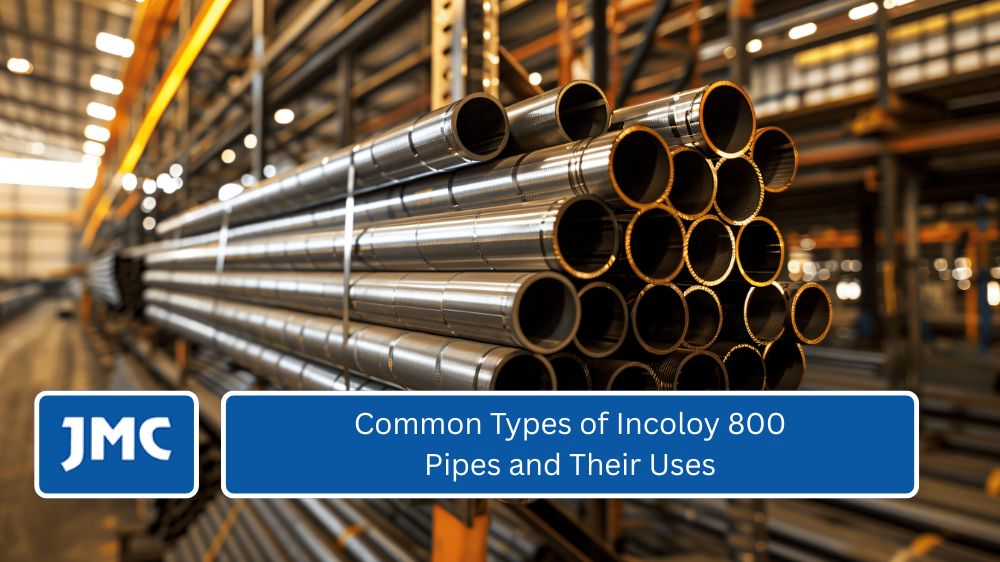
Incoloy 800 seamless pipes come from a solid billet that is hollowed and drawn without a weld seam, giving uniform wall thickness and the highest pressure tolerance in the range. Plants use them for high-pressure steam lines and reactor piping where a weld joint would add risk.
Incoloy 800 welded pipes form from rolled plate joined at the seam, then heat-treated to restore mechanical properties. They suit large-diameter runs where seamless production becomes impractical.
Incoloy 800 ERW pipes are produced by electric resistance welding, which involves passing current through the seam edges to fuse them together. This method is ideal for medium pressure transport lines where a clean, consistent weld is required.
Incoloy 800 EFW pipes use electric fusion welding with a filler rod, often producing larger diameters and thicker walls than ERW allows. These pipes show up in power plant ducting and large process vessels.
Incoloy 800 round pipes remain the most common cross-section, fitting standard flanges and fittings across almost every industry that uses this alloy.
Incoloy 800 square pipes and Incoloy 800 rectangular pipes serve structural applications, including furnace frames and equipment supports, where a flat surface matters more than circular flow dynamics.
Key Properties of Incoloy 800 Pipes
Several properties explain why this alloy keeps appearing in demanding specifications. It resists oxidation up to 1100°C, retains strength under sustained mechanical load, and pushes back against carburization even in carbon-rich furnace gases. Creep and rupture strength stay high through extended service, while general corrosion resistance covers acids, alkalis, and many process chemicals. Fabricators report that Incoloy 800 pipes weld cleanly using standard TIG and MIG techniques, and Incoloy Alloy 800 Pipes routinely log 15 to 20 years of service in continuous high-temperature duty.
Industrial Uses of Incoloy 800 Pipes
These pipes appear across a wide spread of heavy industry. Heat exchangers use them to move thermal energy without losing structural integrity over thousands of cycles. They are employed in chemical processing plants for the passage of corrosive feedstocks. They are utilized by petrochemical industries in cracking units and high temperature transfer lines. UNS N08800 Pipes are used in the superheater and reheater sections of power generation plants. They are used as furnace muffles and retorts in heat treatment equipment. Furnace components, oil and gas separation systems, and nuclear power applications round out the list, with nickel iron chromium alloy pipes handling steam generator tubing.
Advantages of Using Incoloy Alloy 800 Pipes
Operators choose this alloy because it performs in conditions that destroy ordinary materials within months. It resists oxidation and corrosion at once, carries high mechanical strength into the 900-1000°C range, and extends operating life well beyond carbon steel alternatives. The less often it needs to be replaced, the less maintenance costs you have over the lifetime of the plant. The alloy can take thermal cycling without the cracking that is a problem with less ductile materials.
Factors to Consider When Choosing Incoloy 800 Pipes
Before specifying these pipes, engineers should weigh the operating temperature against the alloy’s rated limits, then assess the corrosive media involved, whether acidic, alkaline, or carburizing. Pressure requirements determine wall thickness and schedule selection, while pipe dimensions need to match existing fittings and supports. Most buyers require compliance with ASTM and ASME standards and welding requirements should be confirmed early as post-weld heat treatment can impact timelines. Budget and lifecycle cost deserve equal weight against upfront price, since a cheaper pipe that fails in three years rarely beats one that runs for fifteen.
Conclusion
Industries that push equipment into extreme heat and corrosive chemistry need materials that do not buckle under the strain, and Incoloy 800 Pipes consistently deliver that performance. Each type of Incoloy Alloy 800 Pipe, from seamless and welded variants to round, square and rectangular cross-sections, plays a specific role in chemical, petrochemical and power generation industries. They are resistant to oxidation, carburization and creep, which means longer service life and less unplanned shutdowns. Jayesh Metal Corporation supplies these pipes from its Mumbai warehouse, supporting industries that need dependable performance under demanding thermal and chemical conditions.