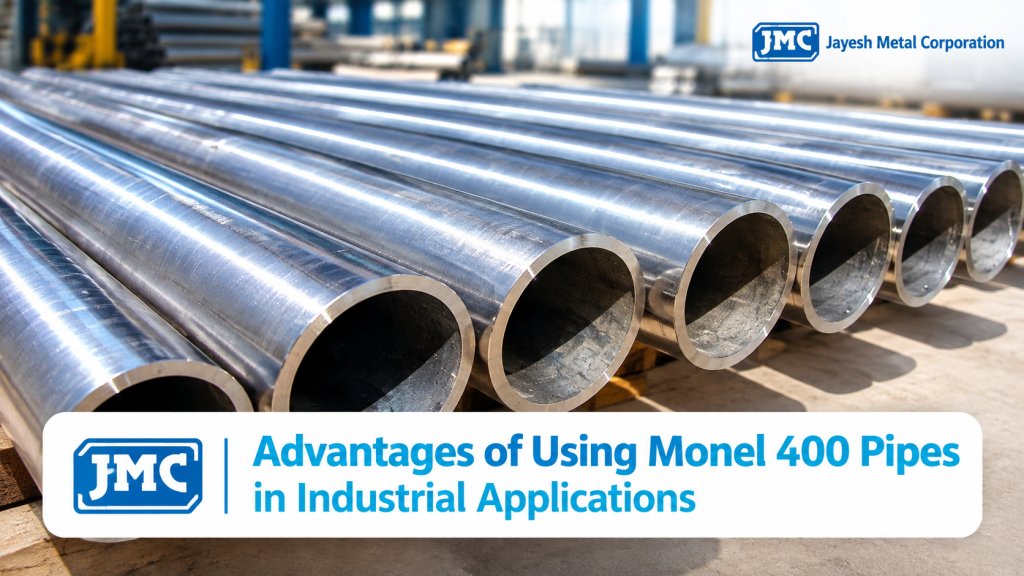
Monel 400 pipes provide industrial systems with excellent resistance to corrosive process fluids, high pressure, and harsh marine environments. Monel 400 pipes, manufactured from a nickel-copper alloy, address this combination in selected demanding environments. This blog covers the main advantages, industrial applications, and key selection factors for Monel 400 pipes across industrial services.
What Are Monel 400 Pipes?
Monel 400 is a nickel-copper alloy carrying approximately 63–70% nickel and 28–34% copper, with small additions of iron and manganese. Pipes produced from this alloy suit selected industrial piping applications where the process medium, operating temperature, and pressure conditions fall within the alloy’s documented compatibility range. Material selection for any piping system depends on evaluating the actual service environment, process fluid chemistry, temperature, pressure class, and fabrication requirements before committing to a grade.
Why Are Monel 400 Pipes Used in Industrial Applications?
Industrial piping systems regularly handle fluids that corrode carbon steel within months and degrade standard stainless steel over a few years. Chloride-bearing seawater, hydrofluoric acid, caustic alkalis, and mixed organic acid streams all create environments where material selection matters more than schedule or cost at the procurement stage. High operating pressures and temperatures compound the challenge, since materials that resist corrosion at ambient conditions can weaken or crack under combined thermal and mechanical stress. Monel 400 pipes enter consideration when operating conditions match the alloy’s documented performance range.
Key Advantages of Monel 400 Pipes
Good Corrosion Resistance
Monel 400 is attacked by hydrofluoric acid, seawater and reducing circumstances less than the usual stainless steels, which are not appropriate for hard service in non-oxidizing chemicals.
Robust mechanical properties
High tensile strength and ductility up to 480 °C and structural stability against thermal expansion and continuous pressure cycling.
Good Performance in Marine Environment
Excellent resilience to salt water and subsea low oxygen service. Applicable to offshore pipelines and heat exchangers with flow rate < 3 m/s
Ideal for Harsh Industrial Environments
Important components where chemical resistance is combined with mechanical strength to assure reliable operation include pump shafts, valve bodies and alkylation units.
Long-range service value
In demanding processing plants, matching carbon steel’s endurance in appropriate environments reduces expensive mid-cycle replacements, shutdowns and maintenance interventions.
Industrial Applications of Monel 400 Pipes
Marine and Offshore Industry
Essential for offshore platform piping, ballast circuits, and splash zone hardware exposed to continuous seawater and salt-air atmospheric corrosion.
Chemical Processing Industry
Widely used in hydrofluoric acid alkylation, fluorochemical processing, caustic soda handling, and aggressive organic acid piping networks.
Oil and Gas Industry
Protects downhole instrumentation, wellhead components, and sour gas service piping against high hydrogen sulfide and chloride concentrations.
Heat Exchangers and Process Equipment
Powers tube bundles in seawater-cooled exchangers and process fluid heaters handling aggressive chemicals or marine cooling water.
Monel 400 Pipes vs Conventional Industrial Piping Materials
| Factor | Monel 400 Pipes | Conventional Materials |
| Corrosion Resistance | Suitable for selected demanding environments | Grade-dependent |
| Mechanical Reliability | Suitable for industrial service conditions | Material-dependent |
| Marine Applications | Suitable for selected flow conditions | Depends on material |
| Initial Cost | Generally higher per kilogram | Often lower |
| Selection | Specialized applications | Application-dependent |
Conventional stainless steel grades cover the majority of industrial piping applications at lower material cost. Monel 400 enters the specification when the specific corrosive environment falls outside standard austenitic or duplex stainless compatibility not as a default upgrade from 316L, but as a targeted selection for conditions the alloy demonstrably handles better.
Factors to Consider Before Selecting Monel 400 Pipes
- Check chemical compatibility and published corrosion data for your process fluid
- Check the mechanical properties of the alloy at its maximum working temperatures
- Determine the wall thickness from the system pressure and pressure classes in use
- Check your dimensions for pipe size and schedule availability
- Assess risks of certain corrosion conditions, such as erosion or pitting
- Welding method qualification of ERNiCu-7 filler metal.
- Match your requirements to standard material specifications such as ASTM B165
- Provide material test certifications for full traceability of heat.
Quality Checks Before Buying Monel 400 Pipes
- Verify the ASTM B165 or B725 specification matches the project requirement
- Check the outside diameter and wall thickness tolerance against the applicable standard
- Review the chemical composition report for nickel and copper within UNS N04400 limits
- Confirm tensile and yield strength test results where mechanical property requirements apply
- Request EN 10204 3.1 mill test certificates traceable to the specific heat number
- Check batch or heat traceability through the full certificate chain
- Confirm any project-specific NDT, hydrostatic test, or inspection requirements before order placement
Conclusion
Monel 400 pipes suit selected industrial applications where the operating environment falls within the alloy’s documented corrosion and mechanical performance range particularly in seawater service, hydrofluoric acid systems, and marine or offshore piping. Material selection should always rest on verified compatibility data for the specific process fluid, temperature, and pressure conditions rather than general grade preference. Review the full operating environment before specifying the grade. Suppliers such as Jayesh Metal can provide Monel 400 pipes in specified forms, sizes, and material conditions, subject to the applicable project requirements.