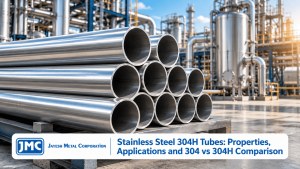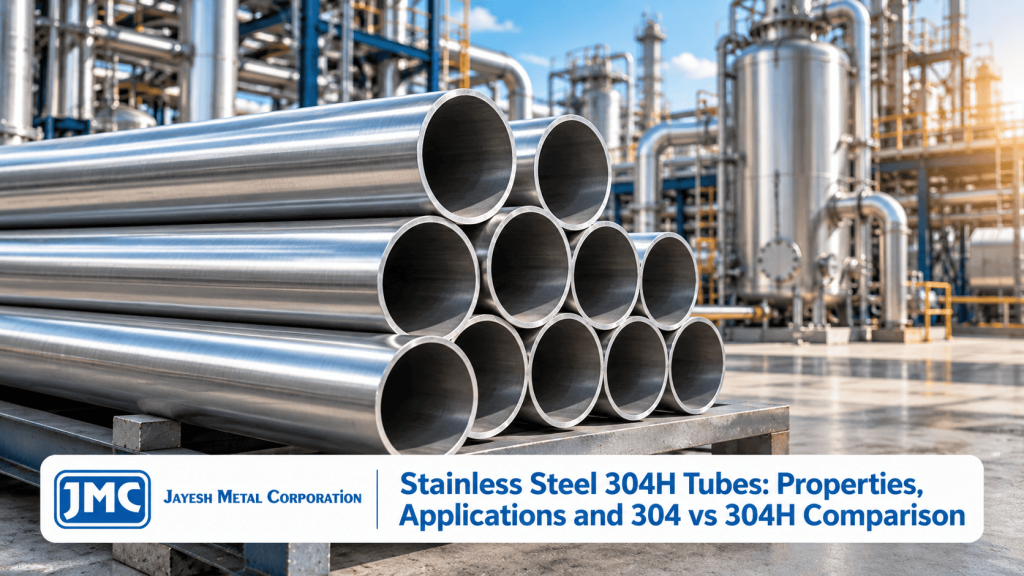
Stainless steel 304H tubes carry a higher carbon range than standard 304, and that change in chemistry determines where each grade belongs in elevated temperature service. Refineries, boiler houses and process heaters specify 304H when creep strength determines the design compared to ambient corrosion resistance. Grade selection at this level is not interchangeable.
What Are Stainless Steel 304H Tubes?
Stainless steel 304H tubes are austenitic chromium nickel tubes with a carbon content of 0.04 to 0.10 percent, against the 0.08 percent ceiling that applies to standard 304.
Carbon explains why the H grade exists. Submerged and precipitated as fine carbides during service, it raises strength once temperatures pass the range where 304 begins losing load-bearing capacity. Mills roll the grade into seamless and welded tube, pipe and heat exchanger tubing. ASTM A312 regulates seamless and welded austenitic pipe in TP304H, while ASTM A213 covers boiler, superheater and heat exchanger tube. Both specifications apply to stainless steel 304H pipes and tubes supplied against project documentation.
Key Properties of Stainless Steel 304H Tubes
Five characteristics decide whether the grade suits a given service, and most of them trace back to the carbon range and the grain size control applied at the mill.
- High temperature strength: Creep and stress rupture performance improve over standard 304 under sustained elevated temperature loading, within the limits set by the governing design code.
- Corrosion resistance: Chromium and nickel handle a wide span of industrial environments, though actual performance depends on the process media and the operating conditions at the tube surface.
- Heat resistance: The austenitic structure holds its mechanical properties in elevated temperature applications where the applicable design limits permit the grade.
- Fabrication: Welding and forming follow standard austenitic practice, with procedures qualified against the service requirements of the installation.
- Material standards: Chemistry and mechanical values need verification against the governing specification before the material is accepted.
SS 304 vs SS 304H Tubes: Key Differences
Carbon content is the only deliberate difference in chemistry between the two grades, but it changes how each grade performs once service temperature increases. The table sets out the practical consequences.
| Parameter | SS 304 | SS 304H |
| Carbon Content | Lower | Higher |
| High-Temperature Strength | Suitable for many general applications | Better suited to certain elevated-temperature service conditions |
| Typical Selection | General corrosion-resistant applications | Applications requiring improved high-temperature strength |
| Common Consideration | General service requirements | Temperature, stress, design code, and operating conditions |
Grade selection follows the application, the design requirements and the material specification named in the purchase documentation. Neither grade qualifies the other on chemistry alone, and the design code usually resolves the matter before the buyer does.
Industrial Applications of Stainless Steel 304H Tubes
Three sectors represent the most 304H tube consumption, and each specifies the grade for the same underlying reason: sustained heat combined with mechanical load.
Boilers and Heat Exchangers
Boiler and heat exchanger circuits run tube walls at elevated metal temperatures under internal pressure. The H grade holds creep strength through those duty cycles, so the superheater and reheater bundles name it on the material list.
Petrochemical and Chemical Processing
Reformer piping, cracking furnaces and hot transfer lines expose tube surfaces to aggressive process streams. Corrosion performance differs depending on the media, so engineers choose the grade based on a corrosion review rather than on temperature figures alone.
Power Generation and Industrial Furnaces
Power plants and furnace builders specify 304H for high temperature piping, headers and radiant sections where the design code permits the grade. Traceable certification supports material acceptance on these projects.
How to Select the Right SS 304H Tubes
Buying the grade correctly means settling five variables before the purchase order goes out, since each one affects whether the delivered tube clears inspection.
- Operating temperature and pressure across the full duty cycle, including upset conditions.
- Required outside diameter, wall thickness and length tolerance.
- Corrosion conditions and process media in contact with the tube surface.
- The ASTM grade or project specification named in the enquiry documents.
- Material test certificates and heat number traceability for every supplied lot.
Conclusion
Carbon content distinguishes SS 304 from SS 304H, and the higher range gives the H grade its advantage once sustained temperature and stress are considered. Standard 304 still suits general corrosion service. Specify the design code, operating conditions, and applicable material standard. View full specifications and submit enquiries on the stainless steel 304H pipes and tubes page.