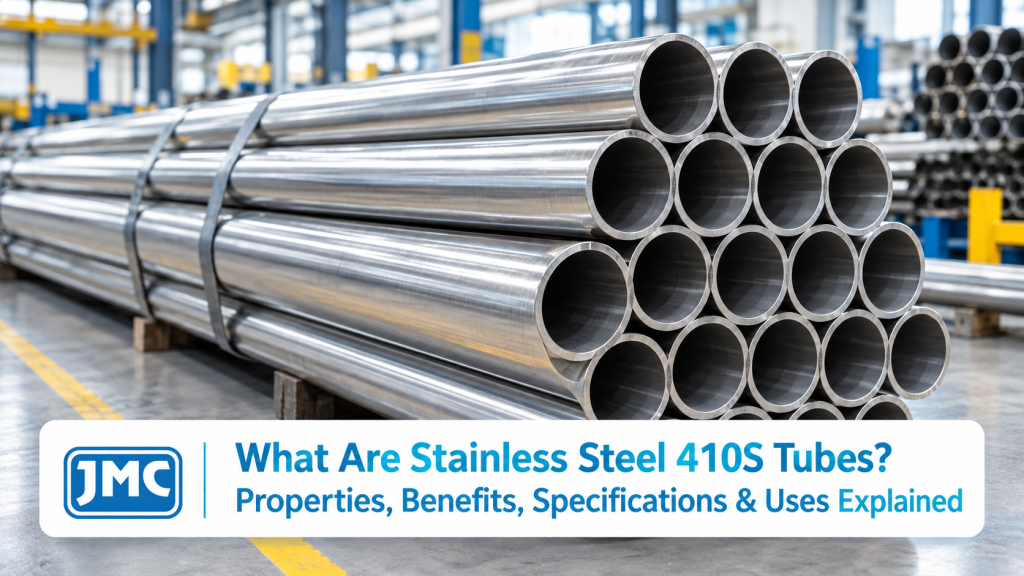
Stainless steel 410S tubes provide reliable corrosion and high-temperature resistance, ensuring optimal material performance in demanding real-world applications. Stainless Steel 410S Tubes are used in industrial applications when a ferritic, non-hardening grade is required in place of normal austenitic alloys. The Stainless Steel 410S Tubes is the complete reference for all the information you need, including the quality, specs, and uses for these tubes.
What Are Stainless Steel 410S Tubes?
Grade 410S is a low-carbon variant of standard 410 martensitic stainless steel, though it behaves as a ferritic grade during typical fabrication and service. By capping carbon content at 0.08% maximum, the alloy prevents hard martensite from forming during welding or heat treatment. This makes 410S non-hardening and ideal for applications requiring strict post-fabrication hardness control.
Key Properties of Stainless Steel 410S Tubes
Corrosion Resistance
410S is very stable in oxidising conditions, moderate organic acids, and air circumstances where a protective coating is formed from its chromium component. But it is not intended for acid reduction, heated chloride solutions or hostile chemical conditions where higher-alloy austenitic grades are needed.
Oxidation Resistance
The alloy withstands scaling in clean oxidizing atmospheres at temperatures up to around 700°C in intermittent service and 650°C in continuous service. This makes it a perfect choice for parts of furnaces and thermal equipment within the limits of extreme alloys.
Good Weldability
Unlike standard 410, lower carbon allows welding without mandatory preheating or post-weld heat treatment to prevent heat-affected zone cracking. Standard practices with matching or slightly over-alloyed fillers ensure sound, ductile joints.
Thermal Stability
As a ferritic stainless steel, 410S avoids the phase transformations that complicate heat treatment in higher-carbon grades. This microstructural stability keeps components dimensionally consistent through repeated heating and cooling cycles.
Mechanical Properties
Tensile strength of 410S in annealed condition is in the range of 415–550 MPa,, and the yield strength is in the range of 205–275 MPa. These values are suitable for lightly loaded process lines and structural tubing, but pressure estimates must include code-derated strains at hot temperatures.
Main Benefits of Stainless Steel 410S Tubes
Suitable for High-Temperature Applications
410S is well up to the job of components such as furnace muffle tubes in the 500°C to 700°C range. Its ferritic structure prevents sigma-phase embrittlement so that the thermal cycling may be predicted throughout long-term service intervals.
Good Fabrication Characteristics
Cold forming, tube bending, and machining proceed using standard stainless steel tooling. Because the material does not work-harden aggressively, cut edges and formed zones maintain consistent, predictable hardness levels.
Reliable Industrial Performance
Matching grade and wall thickness to real operating conditions directly improves long-term plant uptime. In suitable thermal environments, 410S retains dimensional integrity and surface condition through extended operational runs.
Cost Considerations
With minimal nickel content, 410S offers a cost-effective alternative to austenitic alloys like 316 or 321. When process conditions fall within its performance envelope, it delivers dependable durability without the price premium of higher-nickel grades.
Specifications to Check Before Buying Stainless Steel 410S Tubes
Confirm these essential parameters before placing an order:
- Manufacturing Standards ASTM A213 or ASTM A511 (Seamless/Welded) ASTM A268 (TP410S)
- Dimensional Specifications: Verify OD, wall thickness and cut to length tolerances.
- Chemical Profile: Check that max carbon (0.08%), chromium (11.5-13.5%) and nickel (0.60%) are within UNS S41008 standards.
- Testing requirements: Hydrostatic, eddy current or ultrasonic test and EN 10204 3.1 mill test certifications required
Common Applications of Stainless Steel 410S Tubes
Industrial Furnaces
Application: Used in muffle tubes, burner nozzle liners and internal frames for service at 500–700°C when oxidation resistance and ease of manufacturing are more important than high-temperature tensile strength.
Heat Treatment Equipment
Suitable for normalizing fittings, tube banks in controlled environment furnaces, and structural tubing where phase stability prevents breaking of the junction during the repeated temperature cycling of batches.
Petrochemical and Process Lines
Used in moderately corrosive conditions at temperatures below 650°C when the process fluid chemistry is compatible with the protective capabilities of chromium-passive films.
High-Temperature Equipment
Cost-effective thermal resistance in power plant heat recovery systems for flue gas ducting and waste heat equipment.
Stainless Steel 410S Tubes vs Other Grades
| Factor | Stainless Steel 410S Tubes | Other Stainless Steel Grades |
| Microstructure | Ferritic | Grade-dependent (austenitic, duplex, martensitic) |
| Max Service Temp | Up to ~700°C (oxidation service) | Grade-dependent |
| Corrosion Profile | Moderate environments | Austenitic/duplex handle chlorides better |
| Weldability | Good without mandatory PWHT | Grade-dependent |
| Application Focus | Thermal stability & cost savings | Broader chemical & extreme pressure service |
How to Select the Right Stainless Steel 410S Tubes
Before finalizing your engineering order, evaluate these key operational factors:
- Operating Envelope: Verify maximum temperature, thermal cycling frequency and pressure limits.
- Atmosphere and Fluid Process: gas composition; No aggressive chloride attack
- Fabrication Scope: Please specify the joint design, filler metals and whether post-weld annealing is essential in your design.
- Quality and Traceability: Review mill test certificates for UNS S41008 chemical and mechanical requirements.
Quality Checks Before Purchase
- Verify UNS S41008 / ASTM A268 TP410S material callouts match project documents.
- Check dimensional tolerances for wall thickness and outer diameter against mill standards.
- Confirm tensile, yield, and elongation test results on the mill test report.
- Review heat numbers on certificates to ensure full physical traceability across every bundle.
Conclusion
Stainless Steel 410S Tubes offer a good combination of oxidation resistance up to 700 °C, ease of weldability and ferritic phase stability for industrial furnaces, heat treatment units and moderate process pipes. It does not directly replace high-nickel alloys in hostile acid or chloride service, but offers exceptional reliability and value when its qualities match the service circumstances. Check your system’s temperature, fluid chemistry and pressure demands to see if 410S will be a good fit for your project. See sizing, scheduling and certification availability on the Triton Plates stainless steel 410S.