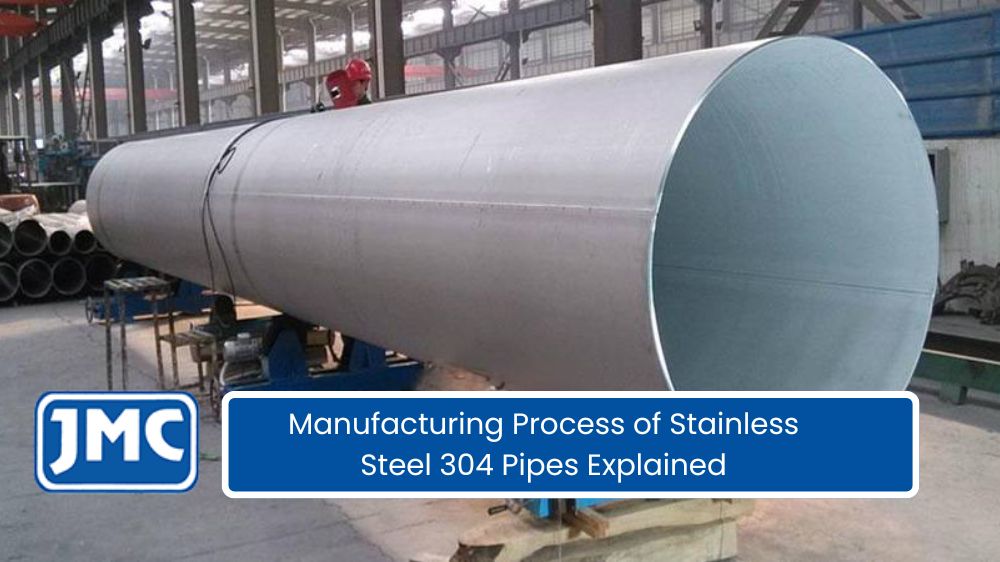
Stainless Steel 304 Pipes rank among the most specified pipe materials across industrial, commercial, and residential construction. Corrosion resistance, mechanical strength, and environmental adaptability have driven steady demand growth from food processing to petrochemicals. Knowing how these pipes are manufactured directly informs procurement decisions, quality benchmarking, and performance expectations. This guide walks through the complete stainless steel pipe manufacturing process, from raw material selection to finished product, covering differences in seamless vs welded stainless steel pipes and primary SS 304 pipe applications.
What Are Stainless Steel 304 Pipes?
Stainless Steel 304 Pipes are austenitic grade pipes made of Grade 304 stainless steel, the most widely produced alloy grade in the world. The chemistry is precise. Its chromium content is 18-20% and the nickel content is 8-10.5%. The presence of this chromium builds a self-healing passive oxide layer on the surface of the pipe, which provides corrosion resistance without any coating on top.
SS 304 Pipes have good weldability and tensile strength at a wide range of service temperatures, which makes it a popular specification for food processing, chemical fluid handling, water distribution and general industrial piping.
Raw Materials Used in SS 304 Pipe Manufacturing
The starting point is stainless steel coils, billets or slabs, selected based on whether the finished pipe will be seamless or welded. Chromium and nickel must land within grade-specific tolerances. Even a marginal deviation affects corrosion resistance and mechanical behaviour in service.
Reputable manufacturers use materials that meet ASTM and ASME standards. These standards define the required chemical composition, mechanical strength, and tests that must be done before production. Meeting them is the basic quality requirement before any manufacturing begins.
Manufacturing Process of Stainless Steel 304 Pipes
The stainless steel pipe manufacturing process is a controlled, sequential operation where each stage depends on the precision of the one before it, and deviations at any point carry forward into the finished pipe.
Melting and Alloy Preparation
Raw stainless steel is loaded into an electric arc furnace, melted above 1,600°C, and refined through argon oxygen decarburisation to achieve the chromium and nickel concentrations that Grade 304 compliance requires.
Casting Process
The refined alloy is continuously cast into billets or slabs. Casting geometry is determined by whether downstream processing will follow the seamless or welded route, since each requires different cross-sectional input dimensions.
Pipe Forming Process
Seamless pipes are formed by heating billets to rolling temperature, piercing them through a rotary mill, and elongating them over a mandrel into a seamless hollow cylinder. Welded pipes follow a separate path, with flat stainless coil progressively roll-formed into a tubular profile before the edges are brought together for welding.
Method of welding
SS 304 Pipes are welded using TIG welding or ERW. The TIG process uses an inert gas-shielded tungsten electrode to produce a precise, high-integrity joint. ERW welds edges by electrical resistance under pressure, providing predictable dimensions for standard industrial specifications.
Heat Treatment and Annealing
This controlled heating and rapid cooling process relieves residual stresses from mechanical forming, restores ductility and re-establishes corrosion resistance that is disrupted by high temperature processing. An abbreviated or skipped annealing cycle has measurable consequences on pipe performance.
Sizing and Straightening
Sizing Mills bring outer diameter and wall thickness into close conformance with target specifications. The straightening equipment corrects axial bow or curvature introduced during forming or heat treatment, which has direct effects on how pipes fit within an assembled system.
Surface Finishing and Polishing
Mechanical polishing removes surface irregularities. Pickling dissolves heat tint and restores the chromium oxide layer across the full pipe surface. For Stainless Steel 304 Pipes in food or pharmaceutical service, surface finish is a hygiene and regulatory requirement, not an aesthetic consideration.
Quality Testing and Inspection
Every batch undergoes hydrostatic pressure testing, dimensional inspection, and chemical composition verification. Where specifications demand it, non-destructive testing detects sub-surface discontinuities. No compliant Stainless Steel 304 Pipe leaves a facility without documented results confirming it meets the specification.
Types of Stainless Steel 304 Pipes Based on Manufacturing
The production method directly determines the structural and performance profile of the finished pipe, and selecting the wrong type for an application is a common, avoidable procurement error.
Seamless SS 304 Pipes
The absence of a weld seam gives seamless pipes uniform wall thickness and consistent mechanical properties throughout the pipe body, making them the correct specification for high-pressure, high-temperature process piping in chemical, power, and energy applications.
Welded SS 304 Pipes
Welded SS 304 Pipes are produced more quickly and at a lower cost than their seamless counterparts. They perform well within moderate pressure and temperature ranges and meet most standard piping requirements in construction, water systems and manufacturing.
ERW Stainless Steel Pipe
ERW manufacturing provides tight dimensional tolerance and consistent wall thickness, even for large production volumes. These pipes are suitable for applications where precise outer diameter and fitment accuracy are critical for operational performance.
Applications of Stainless Steel 304 Pipes
SS 304 Pipes serve industries with vastly different operating conditions, which reflects how effectively the material balances corrosion resistance, surface quality, and mechanical reliability across demanding environments.
Food and Beverage Industry
Stainless Steel 304 Pipes meet food contact material standards across most regulatory jurisdictions, providing non-reactive, smooth-bore piping that resists caustic cleaning agents and prevents microbial accumulation in hygienic processing systems.
Chemical Processing Plants
SS 304 Pipes are widely used in chemical plants to carry moderately corrosive fluids like dilute acids and alkaline solutions. The passive oxide layer on the surface of SS 304 Pipes reduces the chance of chemical attack and the possiblity of unplanned pipe replacement.
Construction & Infrastructure
Stainless Steel 304 Pipes are used for structural and utility piping in commercial buildings, bridges and public infrastructure projects where exposed installations need to bear load and have a finish that will not degrade over time.
Water Treatment Facilities
In continuously wet, chemically treated environments, pipes with long service life and no dependency on surface coating are required. SS 304 Pipes meet both these requirements, reducing maintenance overhead and the risk of contamination.
Oil and Gas Industry
Upstream and midstream applications in moderate pressure ranges use Stainless Steel 304 Pipes, where the fluid composition does not require a higher alloy grade to provide a cost-effective corrosion-resistant solution without over-specification.
Factors Affecting the Quality of SS 304 Pipes
Pipe quality accumulates across every production stage, and a weakness at any point carries forward into the finished product.
- The composition of the raw material must be within the chromium and nickel tolerances specified for Grade 304, since the chemistry outside these ranges cannot be corrected by downstream processing.
- Effective welding requires uniform heat input and proper inert gas shielding. Any deviation in these results in porosity or micro-cracking in the joint zone.
- Annealing must reach the correct temperature and held long enough to release residual stress. Residual stress is a result of an abbreviated cycle and reduces fatigue resistance under cyclic loading.
- Surface finishing must fully restore the passive oxide layer after thermal processing, since residual scale creates corrosion initiation sites in service.
- Testing and certification to ASTM and ASME requirements provides documented evidence that the pipe meets the mechanical and chemical properties that the manufacturer declares.
How to Choose the Right Stainless Steel Pipe Manufacturer
Not all dealers work on the same level for Stainless Steel 304 Pipes. The ASTM and ASME certifications are proof that the materials and processes meet internationally accepted requirements. A Stainless Steel Pipe Manufacturer, capable of supplying seamless and welded pipes across a broad spectrum of dimensions, supports complex projects without forcing specification compromises.
In-house hydrostatic, chemical and dimensional testing reduces 3rd party inspection dependency and reduces delivery timelines. The availability of custom sizes and consistent stock depth is what really determines if a supplier can truly support projects at scale.
Quick Pipe Quality Checklist
- ASTM/ASME material certification confirmed
- Chemical composition test report available
- Hydrostatic test certificate provided
- Dimensional inspection records available
- Heat treatment documentation included
Conclusion
The manufacturing process of Stainless Steel 304 Pipes is from electric arc melting and continuous casting to forming, annealing, surface treatment & inspection. Each stage contributes to the corrosion resistance, mechanical strength and dimensional accuracy that makes SS 304 Pipes a reliable specification for food processing, chemical handling, water treatment and construction. The quality of manufacture will determine whether a pipe will perform as designed over its service life.