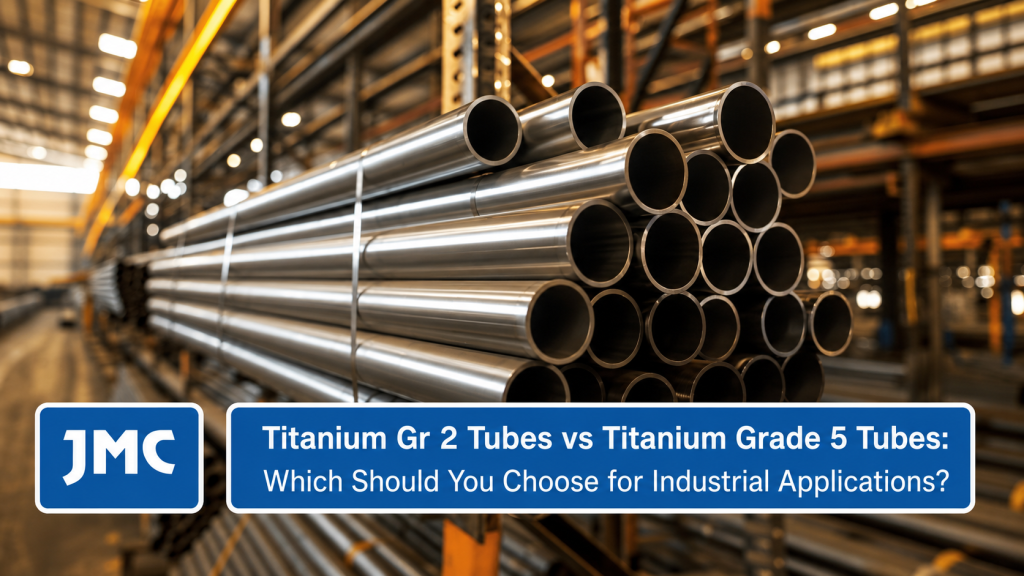
Two titanium grades dominate industrial tubing specifications, and the gap between them decides how a system performs under corrosion, load and heat. Titanium Gr 2 Tubes deliver commercially pure titanium with strong resistance to aggressive media, while Grade 5 brings alloy strength for demanding structural work. Both resist corrosion well, yet each suits a different application. Picking the wrong one raises cost, weakens fabrication, or shortens service life across a plant.
Understanding Titanium Gr 2 and Titanium Grade 5 Tubes
Grade 2 titanium is a commercially pure metal, close to 99% titanium with trace iron and oxygen. It bends, welds, and forms with little effort, which is why fabricators reach for it in heat exchangers and process lines. Grade 5, known as Ti-6Al-4V, blends 6% aluminium and 4% vanadium into the titanium base. That alloying nearly doubles tensile strength. Grade 2 tubes carry chemicals and seawater without pitting, while Grade 5 tubes hold up under mechanical stress in aerospace frames and medical implants. Both belong to the wider family of titanium tubes used across process and structural engineering.
Titanium Gr 2 vs Titanium Grade 5: Key Differences
The two grades split along one line, purity versus alloy strength. This table sets the core properties side by side, followed by short notes on strength, corrosion, fabrication, cost, and service life.
| Property | Titanium Grade 2 | Titanium Grade 5 |
| Material Type | Commercially Pure Titanium | Titanium Alloy (Ti-6Al-4V) |
| Strength | Moderate | High |
| Corrosion Resistance | Excellent | Excellent |
| Weldability | Excellent | Good |
| Formability | Excellent | Moderate |
| Machinability | Easier | More Difficult |
| Cost | Lower | Higher |
| Typical Industries | Chemical, Marine, Heat Exchangers | Aerospace, Medical, High-Strength Engineering |
Strength: Grade 5 carries roughly twice the tensile strength of Grade 2, which is what qualifies it for load-bearing and high-pressure parts.
Corrosion resistance: Both grades resist most acids, chlorides, and seawater, so corrosion alone rarely decides between them.
Fabrication: Grade 2 forms, bends and welds faster, while Grade 5 resists tooling and needs tighter process control. This is where titanium pipe fittings in Grade 2 often pair with Grade 2 tube.
Cost: Grade 2 costs less per metre and less to work, keeping fabricated assemblies within budget.
Service life: Both last for decades in the right setting; the deciding factor is whether corrosion or mechanical load drives failure.
Why Titanium Gr 2 Tubes Are Preferred for Corrosion-Intensive Applications
Corrosion resistance is where Grade 2 earns its place. The commercially pure structure shrugs off wet chlorine, oxidising acids, and salt water, resisting pitting and crevice attack across a wide pH range. Fabricators prefer it because it’s easy to weld with standard TIG methods and bends tightly without cracking. That combination keeps process plants running with minimal replacement. In seawater cooling, desalination, and chemical handling, Titanium Gr 2 Tubes deliver service lives measured in decades. Lower material and fabrication cost makes the grade the practical choice where load stays moderate, but corrosion never lets up.
When Titanium Grade 5 Tubes Are the Better Choice
Mechanical demand changes the answer. Grade 5 delivers tensile strength near 900 MPa, close to double that of Grade 2, so it carries loads pure titanium cannot. Fatigue resistance is the second advantage. Under cyclic stress, the Ti-6Al-4V structure holds up far longer, which matters in rotating and vibrating assemblies. Aerospace frames, defence hardware, and structural supports rely on that strength-to-weight ratio to shed weight without losing integrity. Grade 5 also serves high-pressure components in oil and gas, where wall stress runs high. When strength and fatigue life set the specification, Titanium Grade 5 tubing handles high-stress applications that Grade 2 cannot accommodate.
Industrial Applications of Titanium Gr 2 and Grade 5 Tubes
Application decides the grade more than any single property. The table below maps common industries against both grades, followed by a short read on where each performs best.
| Industry | Titanium Gr 2 Tubes | Titanium Grade 5 Tubes |
| Chemical Processing | Ideal | Limited |
| Heat Exchangers | Preferred | Sometimes Used |
| Marine & Offshore | Preferred | Used for High-Load Parts |
| Desalination Plants | Preferred | Limited |
| Oil & Gas | Process Equipment | High-Pressure Components |
| Aerospace | Limited | Preferred |
| Medical | Limited | Preferred |
Grade 2 owns the corrosion-driven work: chemical lines, condensers, desalination, and marine cooling, where its resistance and easy welding cut cost and downtime. Grade 5 takes over wherever strength leads. Aerospace structures, medical implants, and high-pressure oil and gas parts all lean on its load capacity and fatigue life.
Factors to Consider Before Choosing Between Titanium Grade 2 and Grade 5
The following factors help decide which grade fits a project. Weigh them together rather than alone, since one dominant factor rarely settles the choice by itself.
Corrosion Environment
Map the media first. Seawater, wet chlorine and oxidising acids favour Grade 2, which resists pitting and crevice attack across a wide pH range without protective coatings or frequent tube replacement.
Mechanical Load Requirements
High tensile and fatigue demands point to Grade 5. Its Ti-6Al-4V structure carries roughly twice the strength of Grade 2, supporting pressure parts and load-bearing frames that pure titanium cannot match.
Operating Temperature
Grade 5 holds strength at higher service temperatures, staying stable through short exposure near 400°C. Grade 2 performs well in warm chemical streams but sheds strength faster as heat climbs above that band.
Weldability Requirements
Grade 2 welds cleanly with standard TIG procedures and needs little post-weld treatment. Grade 5 welds too, though it demands tighter control to avoid brittle zones near the heat-affected region.
Fabrication Complexity
Forming and machining move faster with Grade 2 because of its ductility. Grade 5 resists tooling, wears cutters quicker, and adds shop time, which lifts the finished cost of complex parts.
Budget and Lifecycle Cost
Grade 2 costs less per metre and installs faster, trimming upfront spend. Grade 5 costs more but earns it back where strength prevents failure, cutting downtime across a long service run.
Standards and Specifications
Titanium tube for industrial service runs to ASTM B338 and ASTM B337, which cover seamless and welded titanium tube for condensers and heat exchangers. ASME Section II governs pressure applications, matching each grade to allowable stress. Reputable vendors will provide you with full material traceability from the mill to delivery on every batch. Inspection includes dimensional checks, hydrostatic or eddy-current testing and chemical analysis. With each shipment comes a Mill Test Certificate that documents composition, mechanical values and test results, providing inspectors with a clear audit trail prior to installation.
How to Select the Right Titanium Tube for Your Project
Selection comes down to matching the tube to real operating conditions, not to strength figures alone. These five checks keep the decision grounded in what the application needs.
- Match the grade to your operating conditions before comparing price, since the wrong metal fails faster than any saving justifies.
- Weigh corrosion resistance against mechanical strength and let the more demanding requirement guide the final grade choice.
- Account for fabrication and welding needs early, because Grade 2 shapes and joins with far less shop effort.
- Review the applicable ASTM and ASME standards so the tube meets the code your project inspection demands.
- Consult a trusted titanium tube supplier who can confirm stock, certification, and lead time before you commit.
Conclusion
Titanium Grade 2 and Grade 5 serve distinct industrial applications. Titanium Gr 2 Tubes are best suited for corrosion-heavy service, offering strong chemical resistance, easy welding, and lower cost for process plants. Grade 5 earns its place where high strength and fatigue life carry the load. Select the appropriate grade based on operational requirements rather than tensile strength alone. Jayesh Metal Corporation maintains a comprehensive inventory of Titanium Grade 2 and Grade 5 tubes at its Mumbai warehouse, fully equipped to support global import and export requirements with immediate dispatch.