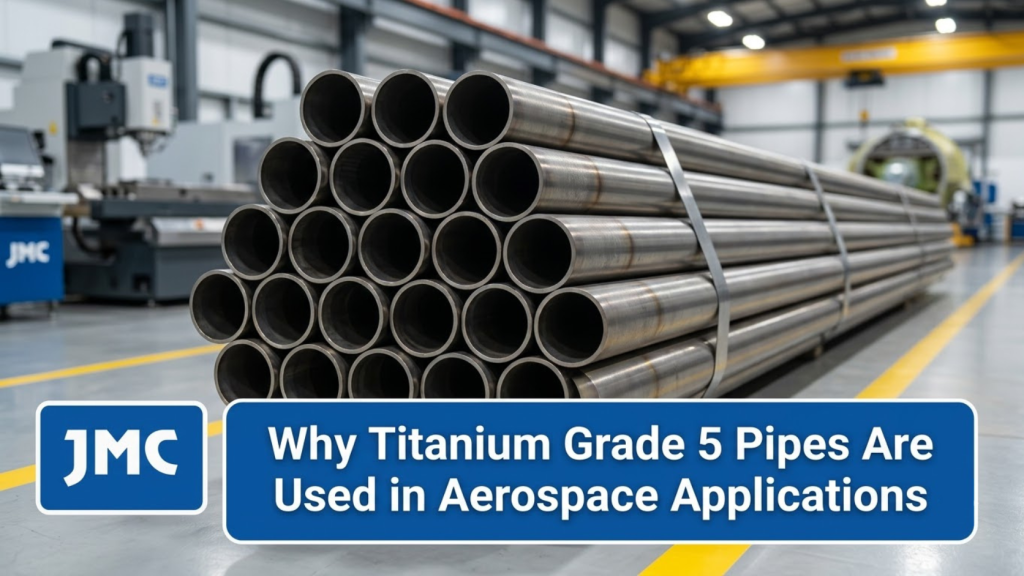
Aerospace engineers often need tubing to carry fluid or air while keeping system weight under control. Titanium Grade 5 pipes, also known as Ti-6Al-4V or UNS R56400, provide a combination of strength, relatively low density, and corrosion resistance that makes the alloy suitable for demanding aerospace systems. ASTM B861 identifies Grade 5 as UNS R56400 titanium alloy and includes it within its specification for titanium and titanium alloy seamless pipe.
The important point is that Grade 5 titanium is not selected simply because it is an aerospace material. The suitability of a particular tube depends on its dimensions, manufacturing condition, mechanical requirements, service environment, testing, and governing material or aerospace specification.
Where Are Titanium Grade 5 Pipes Used in Aerospace?
Titanium tubing can be considered for aerospace systems where low mass, mechanical performance, environmental resistance, and service conditions are important. Ti-6Al-4V has been documented in aerospace tubing and airframe-related applications.
Common application categories include:
- Aircraft hydraulic systems
- Fluid-routing systems
- Air and gas-routing systems
- Tubular aerospace components
- System assemblies requiring lightweight metallic tubing
The specific application depends on operating pressure, temperature, mechanical loading, environmental exposure, tube dimensions, joining requirements, and the applicable specification. Hydraulic tubing is one important application and requires particular attention to pressure cycling, fatigue, bending, and fitting compatibility.
High Strength Without Excessive Weight
Weight is a primary consideration in aerospace design. Hydraulic and other fluid-routing systems require tubing that can withstand pressure and mechanical loads without adding unnecessary mass.
Grade 5 titanium provides a useful combination of mechanical strength and relatively low density. This allows designers to evaluate lightweight tubing configurations where the applicable calculations and specifications permit them.
The benefit becomes more significant when tubing runs extend across an aircraft or when numerous lines are installed throughout a system. Reducing the mass of individual tubes can contribute to overall system weight reduction.
However, the final tube design depends on more than alloy selection. Diameter, wall thickness, pressure requirements, manufacturing condition, fittings, support spacing, and applicable aerospace requirements all affect the finished component.
Hydraulic Tubing Applications
Hydraulic systems are an important aerospace application for titanium alloy tubing because aircraft hydraulic lines must withstand internal pressure while also accommodating vibration, temperature changes, and repeated loading.
Ti-6Al-4V has been studied in connection with aircraft hydraulic tubing, including its behavior and limitations under hydraulic pressure. This makes hydraulic service a useful example of why the alloy, tube geometry, operating conditions, and manufacturing requirements need to be evaluated together.
For hydraulic applications, engineers need to consider:
- Operating pressure
- Tube diameter and wall thickness
- Fatigue requirements
- Bend and forming requirements
- Fitting compatibility
- Temperature exposure
- Pressure cycling
- Applicable aerospace material specification
Titanium alloy tubular components are also documented in aircraft hydraulic and landing-gear system hardware. The application therefore involves more than selecting a titanium alloy: the tube and associated components must satisfy the requirements of the complete hydraulic system.
Fluid and Air Routing Systems
Aircraft tubing may transport liquids or gases between system components. These lines can be exposed to vibration, temperature cycling, environmental conditions, and repeated mechanical loading during service.
Grade 5 titanium can be considered for such routing applications when its mechanical and environmental properties meet the system requirements. Its relatively low density can be useful where long tubing runs or multiple lines contribute to overall aircraft weight.
The application also requires consideration of the transported medium. Fluid compatibility, operating temperature, pressure, tube dimensions, joining methods, and environmental exposure can influence whether Grade 5 titanium is appropriate for a particular routing system.
Corrosion Resistance for Aerospace Service
Titanium develops a stable oxide film that provides strong resistance to many corrosive environments. This characteristic is valuable when aerospace tubing is exposed to moisture and other environmental conditions during service.
Corrosion resistance can help reduce concerns associated with long-term environmental exposure and maintenance. However, Grade 5 titanium should not be treated as universally corrosion-proof. Material compatibility depends on the service medium, environment, temperature, concentration, and operating conditions.
The actual service environment should therefore be evaluated before Grade 5 titanium is approved for a particular aerospace tubing application.
Fatigue and Repeated Loading
Aerospace tubing does not remain under one constant load throughout its service life. Hydraulic pressure cycles, vibration, thermal variations, and aircraft operation can all produce repeated stresses.
Fatigue performance is therefore an important consideration when selecting tubing for aerospace systems. The evaluation should account for tube geometry, surface condition, pressure cycles, connections, bends, and installation conditions.
A suitable material designation does not by itself establish fatigue performance for a particular aircraft system. The complete tube design and loading conditions must be considered.
Temperature and Service Conditions
Aerospace tubing can experience temperature changes during ground operation, flight, and exposure to different aircraft environments. These conditions can affect mechanical properties, dimensional stability, and compatibility with the transported medium.
Grade 5 titanium is included in ASTM B861, which covers titanium and titanium alloy seamless pipe intended for general corrosion-resisting and elevated-temperature service. The specification establishes requirements for chemical composition, mechanical properties, and specified testing.
This does not mean every Grade 5 pipe is suitable for high-temperature aerospace service. The actual temperature range, pressure, heat-treatment condition, wall thickness, and governing specification must be verified for the intended application.
Seamless and Welded Pipe Options
Grade 5 titanium is covered by both seamless and welded titanium pipe specifications.
ASTM B861 covers titanium and titanium alloy seamless pipe and includes Grade 5, UNS R56400. The specification addresses chemical composition, mechanical properties, and testing requirements such as tension, flattening, bend, and hydrostatic testing.
ASTM B862 covers titanium and titanium alloy welded pipe and also includes Grade 5, UNS R56400. Its requirements address chemical composition, mechanical properties, and manufacturing conditions applicable to the grades within its scope.
ASTM B338 should be treated differently because it covers seamless and welded titanium and titanium alloy tubes specifically for condensers, evaporators, and heat exchangers. It should therefore not be presented as a general-purpose aerospace tubing specification.
Fabrication and Dimensional Requirements
Selecting the alloy is only one part of producing aerospace tubing. Manufacturing method, heat treatment, dimensional tolerances, surface condition, forming requirements, and joining methods can all affect final performance.
Titanium tubing also requires controlled fabrication practices. A tube that meets the nominal Grade 5 chemistry may still fail to meet an application requirement if its dimensions, material condition, testing, or manufacturing specification are unsuitable.
This is particularly important for hydraulic tubing, where bends, fittings, pressure cycles, and installation geometry can influence service performance.
How Engineers Should Specify Grade 5 Aerospace Pipes
Engineers should not specify a pipe simply as “Titanium Grade 5.” A complete procurement specification should identify the required product form, dimensions, manufacturing method, material condition, applicable standard, testing requirements, and documentation.
For aerospace applications, the purchasing team should verify:
- Titanium grade and UNS designation
- Seamless or welded construction
- Outside diameter and wall thickness
- Heat-treatment condition
- Mechanical requirements
- Applicable ASTM or aerospace specification
- Nondestructive or other required testing
- Material traceability and certification
- Application-specific requirements
ASTM B861, for example, establishes chemical, mechanical, and testing requirements for the seamless titanium pipe grades within its scope.
Why Titanium Grade 5 Pipes Remain Relevant to Aerospace
Titanium Grade 5 pipes remain relevant to aerospace because their combination of mechanical strength, relatively low density, and corrosion resistance can address the requirements of demanding tubing systems.
Hydraulic tubing is one important application, while fluid-routing, air-routing, and other tubular aerospace components may also use titanium when the material properties and product specification match the design requirements.
The selection process should therefore evaluate the complete product specification rather than the alloy designation alone. Dimensions, manufacturing condition, mechanical requirements, testing, service environment, and applicable standards all contribute to determining whether Grade 5 titanium tubing is suitable for a specific aerospace application.
Jayesh Metal Corporation can discuss Titanium Grade 5 pipes and tubes according to required dimensions, material condition, testing, and project specifications for aerospace procurement.